Range Hood Repair
Wolf Range Hood Cleaning: Filters, Grease Cups and Liner Care
To clean a Wolf range hood, lift out the baffle or mesh filters and run them through the dishwasher every 3 to 6 months, empty and wash the grease cups, then wipe the stainless with mild soap along the grain. Here is the full routine for Woodinville kitchens.
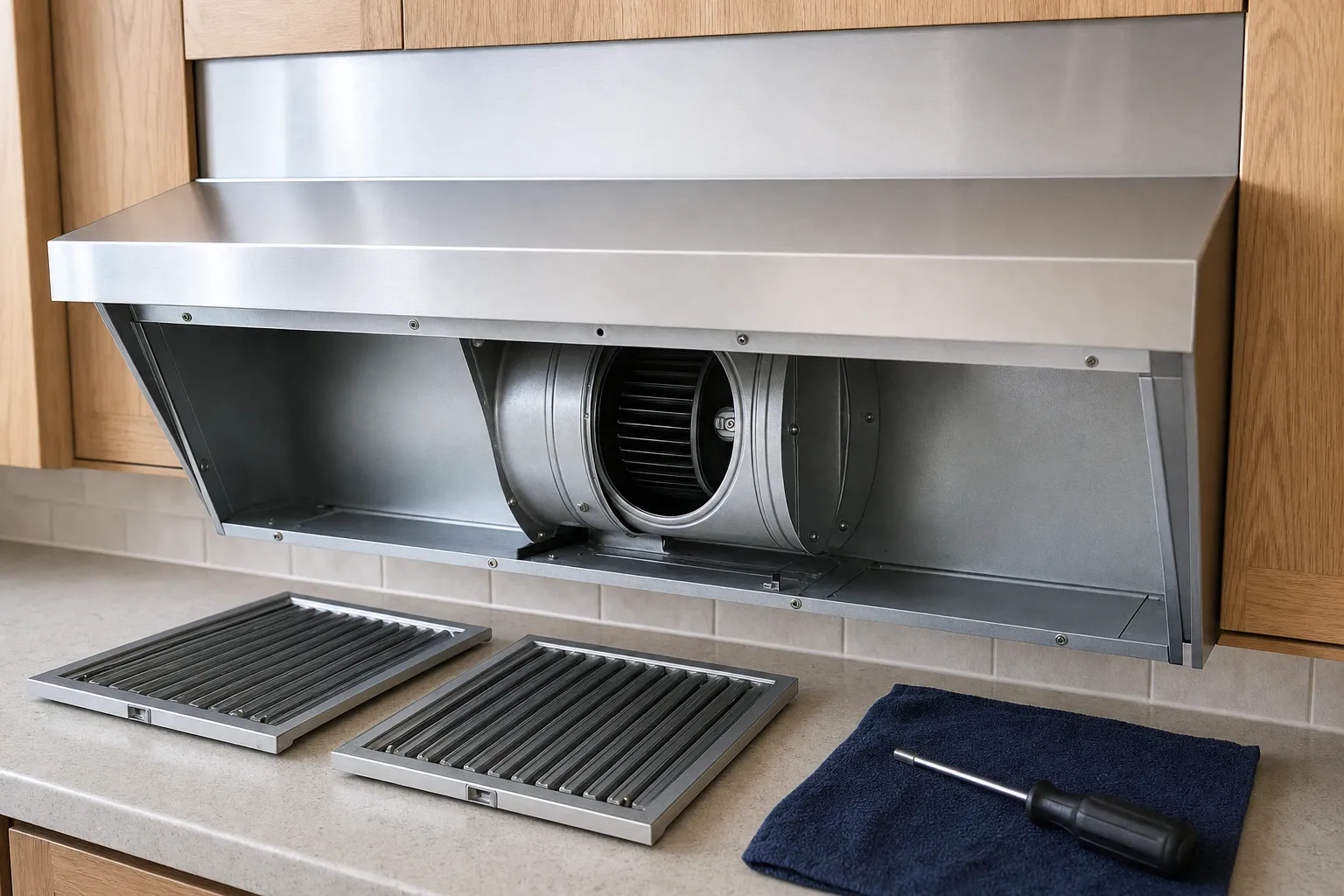
Cleaning a Wolf range hood comes down to three jobs: take out the filters and wash them, empty and wash the grease cups if your hood has them, and wipe the stainless canopy with warm soapy water along the grain. Wolf’s care guide sets the filter routine at every three to six months and confirms that filters, spacers and grease cups can all go through the dishwasher. In Woodinville, the cool, wet months keep kitchen windows shut from autumn well into spring, so the hood is often the only thing pulling smoke and grease out of the house. When its filters clog, you notice it fast: cooking smells hang around and a sticky film settles on the upper cabinets.
Start by working out which hood you own
A pro hood with heavy stainless baffles and a slimmer cooktop hood with mesh screens are cleaned slightly differently. The letters at the front of the model number, printed on the rating label you can usually see inside the canopy once the filters are out, tell you which family yours belongs to.
| Prefix | Hood type | Filter style |
|---|---|---|
| PW, PWC | Pro wall and pro wall chimney hoods | Stainless baffles |
| PI | Pro island hoods | Stainless baffles |
| PL | Pro hood liners | Stainless baffles |
| VW, VI | Cooktop wall and cooktop island hoods | Mesh filters |
| DD | Downdrafts | See its own care sheet |
A few examples make this concrete. A PW302418 pro wall hood takes the 811180 baffle, which measures 11-7/8 by 11-7/8 inches, and an I363418 island hood holds six of those same 811180 baffles. A liner such as the L342212 uses the larger 816311 baffle at 13-1/2 by 12-7/8 inches. On the cooktop side, the VW30S, VW36S and VI42S use mesh filter 825596, while the black glass VW30B and VW36B take 825544. Jot your number down; if a baffle ever gets dropped and bent, you will know exactly what to order.
Taking out filters, spacers and grease cups
Turn off the blower and the lights, and give the burners and the canopy time to cool. Lay a thick towel over the grates so a slipping baffle cannot chip the cooktop. To free a baffle, push it upward into its track, swing the bottom edge toward you and lower it out. Wear light gloves, because the folded edges are sharp and coated in grease.
Pro hoods built from serial number 16314782 onward also have spacers between the baffles and grease cups that collect what drips off them. On every 27-inch-deep wall hood those cups sit along the front, close to the heat lamps. Lift them out and pour the old grease into a lidded can for the trash, never down the sink.
If your kitchen is brand new, check one more thing. Wolf packs the baffles inside the hood for shipping, and installers are supposed to strip off any blue or white protective film and the white foam packing. Peel off anything still stuck to the steel before the hood runs for the first time.
Washing the filters properly
The dishwasher is the easy route. Stand baffles and spacers upright on the bottom rack, set the grease cups beside them and choose the hottest cycle. If the parts are too large or too crusted for that, soak them for fifteen to twenty minutes in a sink of very hot water with a degreasing dish soap, then scrub with a soft nylon brush. Rinse well and let everything dry completely.
Do not be tempted to switch the hood on while the filters are drying. Wolf is clear that the hood should never run without them, since grease would travel straight into the blower and the duct. The three-to-six-month interval is a baseline; homes where the wok, griddle or broiler sees daily use should clean nearer the short end. Our note on how often to clean Wolf baffle filters covers that judgment in more detail.
Wiping the canopy, liner and controls
For the outside, mix warm water with a few drops of mild dish soap, wring out a soft cloth and wipe in the direction of the brushed grain. Follow with a cloth dampened in clean water, then buff dry with a microfiber towel to stop streaks. Spray any cleaner onto the cloth rather than onto the hood, so liquid never runs into the switches or the light sockets. Black glass models want a glass cleaner on a cloth instead.
With the filters removed you can reach the inside of the canopy as well. Wipe the surfaces you can see, but keep your hands out of the blower housing. Every pro wall hood includes a backdraft damper, a flap that stops outside air drifting back in; grease on it can make it stick. In our damp, chilly winters, a duct running through a cold attic or outside wall can also gather condensation that mixes with grease, so if you spot drops on the cooktop, read why water drips from a range hood.
Checking lights and heat lamps while you are there
Pro ventilation hoods use 3000K GU10 bulbs. Remove one with the suction-cup changer that came with the hood: press it on, give a quarter turn and pull. The 27-inch-deep wall hoods also carry R40 heat lamp bulbs rated at 250W, which get very hot, so let them cool for a good while before handling. Wipe the lenses gently with a dry cloth as you go.
When a clean hood still works poorly
If fresh filters and a clean canopy have not brought back strong draw, the cause is somewhere a cloth cannot reach: the blower, a sticking damper or the ductwork. Wolf’s installation guide notes that duct runs longer than 50 feet (15 m) may need a higher CFM blower, which can matter in a large house where the kitchen sits far from an outside wall. Our guide to a hood that runs but will not clear smoke walks through the usual suspects.
When you would rather have a technician look, call (425) 585-2373 or see our Wolf range hood repair service. A single $89 visit covers the trip and the complete diagnosis, and that amount is credited toward the repair once you approve the work. We visit homes in Downtown Woodinville, Hollywood Hill, Wellington and Cottage Lake.
Common follow-ups
Can Wolf hood filters go in the dishwasher?
Yes, Wolf rates the baffle filters, spacers and grease cups on its pro hoods as dishwasher safe. Stand them on the lower rack, run a hot cycle, and let every piece dry fully before it goes back into the canopy. A long soak in hot soapy water in the sink does the same job if they will not fit.
How often should I clean my Wolf range hood?
Wash the filters, spacers and grease cups every three to six months, leaning toward three if you sear, stir-fry or use a griddle several times a week. The outside of the canopy needs a wipe whenever you can feel a tacky film on it, which in a busy kitchen can mean every week or two.
Can I run the hood while the filters are drying?
No, Wolf says the hood must never be operated without its filters installed. With the baffles out, grease rides the airstream straight into the blower and the duct, where you cannot reach it and where it builds into a fire risk. Pause cooking until the dry filters are back in.
What cleaner is safe on a stainless Wolf hood?
Warm water with a few drops of mild dish soap on a soft cloth, wiped in the direction of the grain, is the safest routine cleaner. Avoid steel wool, gritty powders and chlorine bleach, which scratch or spot stainless steel, and buff the surface dry afterward so it does not streak.