Range Repair
Wolf range burner clicks but will not light: what to check
A sealed burner that sparks endlessly and never catches is usually one of four cheap faults, and three of them you can check yourself in ten minutes. Here is the order to work through, and when the clicking means stop.
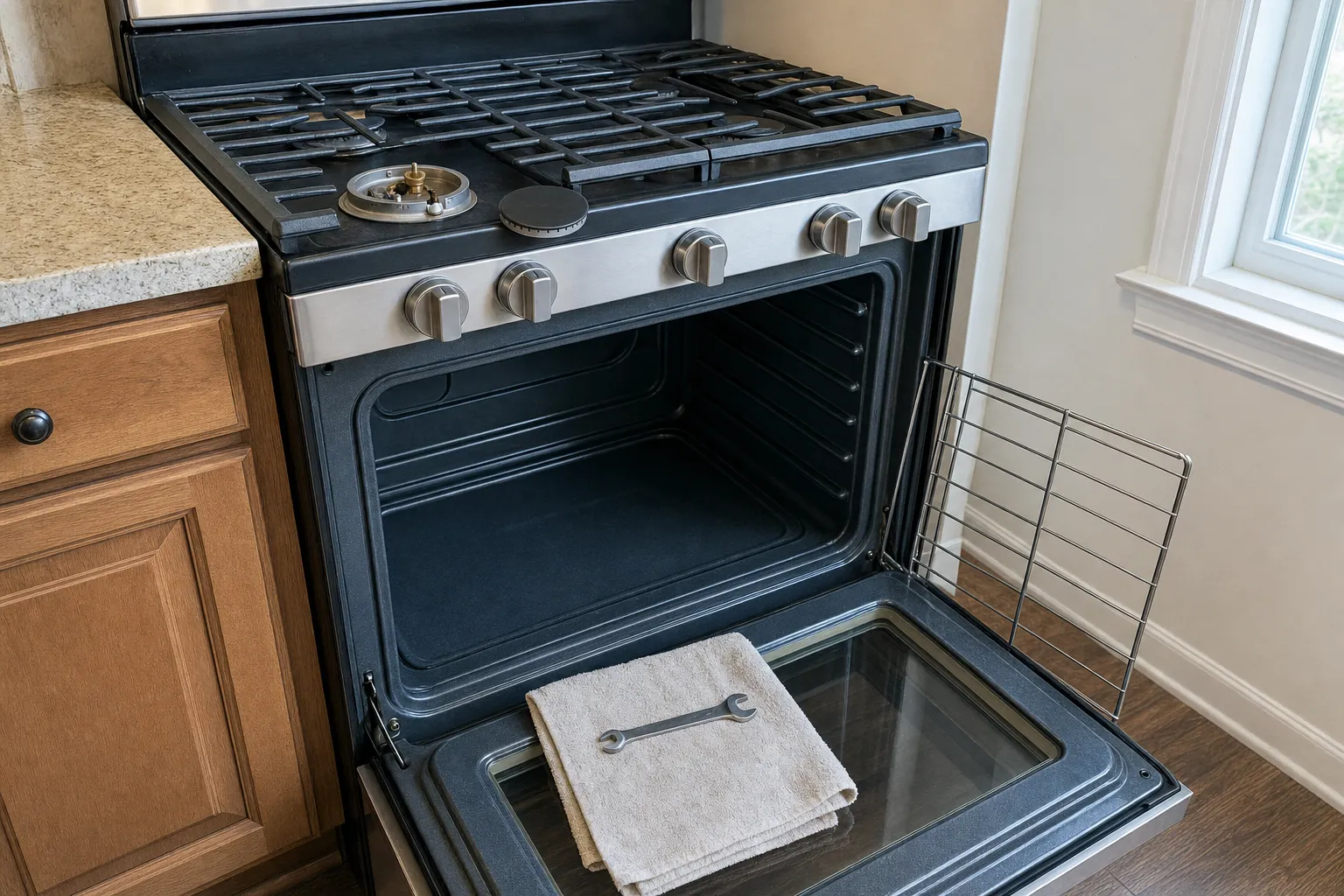
The most common call we take in Woodinville is not a dramatic one. It is a burner that ticks away steadily under a pan and refuses to catch light, on a range that was working perfectly the previous evening. Nine times out of ten the customer has already tried the obvious — turning it off and on again, swapping the pan, wiping the top — and concluded that something serious has gone.
It usually has not. The ignition system on a Wolf sealed burner is a short chain with four links, and the first three cost very little to put right. Working through them in the right order costs you ten minutes and often saves a service call entirely.
The spark is a signal, not the problem
Understanding what the clicking means changes how you interpret it. Turning a knob to the Light position closes a switch that energises the spark module. The module sends high voltage to the electrode sitting beside each burner head, and the resulting arc jumps to the nearest grounded metal — the burner cap. Simultaneously the knob opens the gas valve. Gas meets spark, burner lights, you push the knob back to a flame setting and the module stops.
So a burner that clicks is a burner whose ignition circuit is alive and working. The spark is being generated and delivered. What is failing is either the gas arriving, the arc landing where it should, or the module being told to stop.
That is genuinely good news. Spark modules and gas valves are the expensive end of this system, and a burner that clicks has already demonstrated the module is fine.
Check one: the cap is not seated
This is the cause of more no-light calls than everything else combined, and it is free to fix.
The brass burner head has a cast cap that sits on it, and it only sits correctly one way — there are locating notches. If the cap has been lifted for cleaning and dropped back a few degrees out of alignment, or is sitting proud on a crumb, two things happen. The ports are no longer aligned with the gap the arc has to cross, and the cap is no longer properly grounded.
Let everything cool completely. Lift the cap off, look at the head underneath, then set it back down and turn it gently until it drops into place with no rocking. Press lightly at four points around the edge; it should not move at all. Then try the burner.
If your range has been cleaned recently and one burner stopped working straight afterwards, this is very likely all that is wrong.
Check two: it is wet, or it is blocked
A boil-over that ran down into the burner head is the second suspect. Liquid sitting in the ports or around the electrode does two things: it blocks gas flow through individual ports, and it gives the spark an easier path to ground than the arc gap, so the energy dissipates harmlessly instead of igniting anything.
With the burner cool and off, lift the cap and look at the ring of small ports around the head. They should be open and dry. Clear anything blocking them with a straightened paperclip or a stiff brush — never a toothpick, which snaps and leaves a plug behind, and never a drill bit, which enlarges the port and permanently changes the flame.
Then dry everything. If the range has been mopped or a pot has boiled over within the last few hours, give it several hours more before deciding anything is broken. Moisture that has wicked into the electrode insulator can take a surprisingly long time to leave, and until it does, the burner will click and click.
Check three: the electrode itself
Look closely at the small ceramic-sleeved probe beside the burner head. You are checking three things.
Is the ceramic cracked or chipped? A hairline fracture lets the spark track down the electrode body to ground instead of jumping the gap. You may still see and hear clicking, but the arc is happening in the wrong place. The tell is a faint spark visible at the base of the probe rather than a crisp one at the tip.
Is it carbonised? Years of service leave a conductive soot film on the insulator with the same effect. A gentle wipe with a dry cloth once the appliance is cold is worth doing.
Is it bent? The gap between electrode tip and burner cap is specified for a reason. A probe knocked sideways by a heavy pan or during cleaning either opens the gap too wide to arc across, or closes it so far that the spark grounds without any gas in between. This is repairable, but it is a technician’s job — the electrode is a fragile ceramic component on a fixed lead, and levering it by hand is how a five-minute adjustment becomes a part order.
When it is the gas side, and when to stop
If the cap is seated, the ports are clear, everything is dry, the electrode is intact, and the burner still will not light — and particularly if the other burners on the same range light immediately — the fault has moved to the gas side. That means the valve behind the knob, the internal manifold, or the supply. None of those are DIY territory.
Two situations mean stop straight away rather than continuing to work through the list. If you can smell gas when every knob is in the off position, shut off the supply valve behind the range and call from outside the house — a valve that is passing gas when closed is a different and more serious problem than an ignition fault. And if the clicking continues after the burner has lit, or continues with all knobs off, the spark module or a knob switch is stuck energised. That is not immediately dangerous, but it will not fix itself and it does put a continuous arc next to a live gas appliance.
For everything else, the honest expectation is that this is a small job. Seated caps, cleared ports, dried electrodes and the occasional replaced probe account for the overwhelming majority of clicking burners on Woodinville ranges — and the appliance goes back to lighting first time.
Common follow-ups
One burner is at fault, so why is every burner clicking?
Most Wolf sealed-burner ranges use a shared spark module. When any knob is turned to Light, the module fires every electrode at once. That is normal, and it means a burner that clicks constantly is telling you a switch or an electrode elsewhere is stuck in the light position or wet.
Is it safe to keep trying to light it?
A few attempts, yes. Repeated attempts release unburnt gas into the room. If it has not caught within three or four tries, stop, open a window, wait several minutes and only then try once more. If you can smell gas with the knob off, shut the supply valve and call.
Can I clean a burner cap in the dishwasher?
The cast caps and grates tolerate it, but the detergent dulls the finish over time and any moisture trapped underneath will stop the burner lighting until it dries. Hand washing and thorough drying is the safer habit.