Hood · Parts
Wolf Blower Wheel
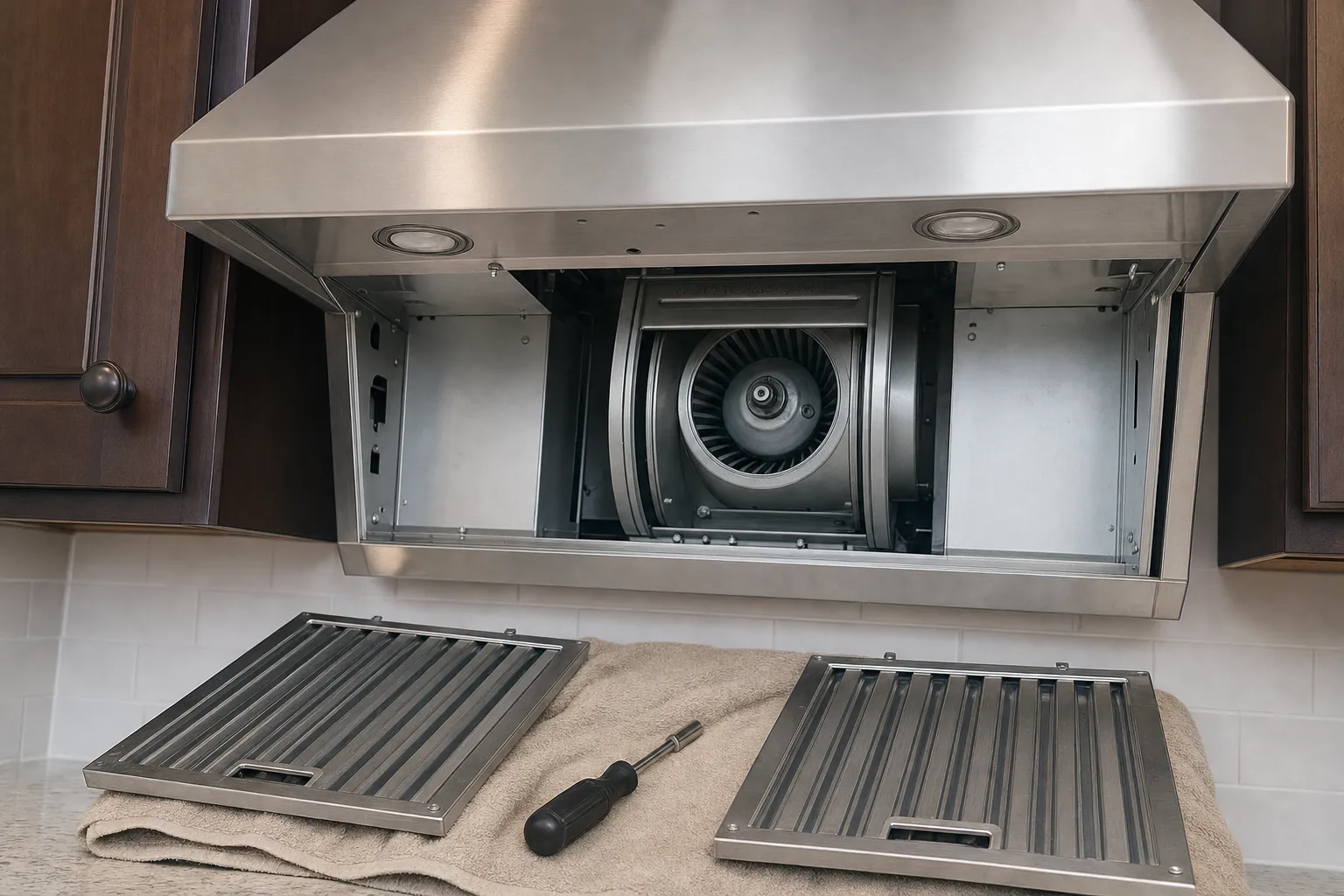
Its job
- Does the real work of moving air: the motor only turns it, and its ring of fins drags smoke through the filters and drives it into the duct.
- Sits on the motor shaft inside the blower housing — Wolf's safety notes call it the impeller.
- Runs smoothly only while it stays clean and true, because at full speed even a small lopsided weight turns into a shake.
Signs it is going
- Picks up a coat of grease when the filters are overdue, and grease that builds unevenly pulls the wheel off balance.
- Draws in drywall and sanding dust during building work, which Wolf names as a cause of noisy, unbalanced impellers.
- Works loose on its shaft or takes a bent fin, then ticks or rattles at one particular speed.
- Keeps shaking once it is out of balance, and that wears the bearings faster than ordinary running ever would.
Our order of work
- Isolate the power, open up the blower and inspect the fins, the grip on the shaft and the gap all round the housing.
- Clean a greasy wheel where it comes up true, and replace one that is bent, cracked or will not sit square.
- Check the bearings of the blower motor on the same visit, since a wheel that has rattled for months seldom leaves them untouched.
Wheel or motor?
A wheel fault usually has a rhythm: a tick, a flutter or a rattle that shows up at one speed and fades at another.
A tired motor is more often a hum, whine or grind that climbs evenly as you turn it up. The two share one housing, so we test them together instead of swapping one and hoping.
After building work in the house
Wolf’s guide asks for drywall spray and construction dust to be kept off the power unit, because it damages bearings and leaves the impeller noisy or unbalanced.
If the hood grew noisy after work in the house, mention it when you ring.
A smooth roar that only rises with speed, with no tick in it, is more often air than wheel. Why a Wolf hood gets loud on high deals with that one.
Two-Minute Check
Run it in order. Nothing here needs a panel off, a ladder or a wire touched.
- Start the hood on its lowest speed and turn it up slowly, noting the setting where any tick or rattle begins.
- Switch off from high and listen while the blower coasts down — a noise that fades as it slows belongs to the turning parts.
- With the hood off and cool, lift out the baffle filters and hold one to the light; heavy grease there usually means some reached the wheel.
- Wash the filters and put every one back before you listen again — never run the blower with them out.
- Stop here — call Wolf Repair Woodinville, (425) 585-2373. Call (425) 585-2373